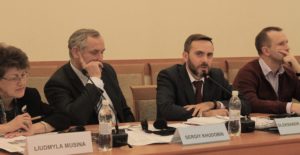
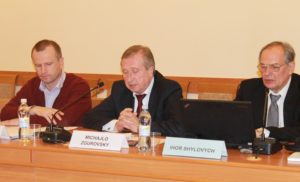
Steering Committee duly evaluated the Centre’s outputs in 2017
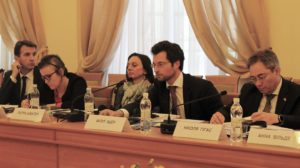 It has become customarily, that this year, like in 2017, the Governing Body Hall at Igor Sikorsky KPI warmly hosted the Steering Committee Meeting (SC). However, this year it was set for April 23, 2018 and was as usual devoted to the UNIDO project “Promoting the Adaptation and Adoption of Resource Efficient and Cleaner Production (RECP) through the Establishment and Operation of a Cleaner Production Centre (CPC) in Ukraine” and its outputs achieved and accumulated through the previous year. Not only the results but identification of the further project perspectives and area of activities up to 2020 were the topics of the meeting.
The following SC members participated in the meeting, namely: Michael Zgurovsky, the rector of Igor Sikorsky Kyiv Polytechnic Institute, Academician of National Academy of Sciences of Ukraine; Philipp Ischer, RECP Project Manager at the Swiss State Secretariat for Economic Affairs (SECO); Petra Schwager, UNIDO Project Coordinator for RECP; Branko Dunjic Chief Technical Advisor of the UNIDO project; Cesar Barahona, RECP Technical Adviser for Latin America and the Caribbean (UNIDO); Nicolas Guigas, Deputy Director of the Swiss Cooperation Office in Ukraine, Emina Alic, Deputy Project Coordinator on RECP; Fredy Dinkel, the environmental expert for Carbotech AG (Switzerland).
Upon session start, Michael Zgurovsky shared the statistics about the Centre’s outputs in 2017 and those were 30 technical assessments fully completed in 6 regions of Ukraine. “Igor Sikorsky KPI is one of the Centre’s founders. And we are totally pleased with the Centre’s development dynamics. We’d like to make everybody sure that KPI will keep on supporting it in all relevant respects, including technical and research potential”.
Igor Shylovych, the Centre’s Director, reported on the main outcomes in 2017. The carried out assessments made it possible to generate 123 technical options on resource efficiency at the enterprises. Provided all of them are implemented, the assessed companies will have got the following savings:
- raw materials and resources – 4329.56 tons;
- chemicals – 926.00 kg;
- water – 128352 m3;
- electricity – 4914.19 MWh;
- heat energy – 24007.72 MWh;
- CO2 emissions total reduction – 6611.86 tons.
Having grasped the 2017 report outcomes, Philip Isher noted: “Three years have passed since the Center faced difficult times in its history due to economic crisis in Ukraine. However, we all have witnessed the Centre survived and made a step forward in self-sustainability. We are very proud of the fact the Centre’s self-sustainability ratio is like 32%. In view of all these facts, our expectations and sincere hopes as well, we do actually believe the Centre in near future will have become capable in progressively going on, strengthen its independence and reaching its maximum levels of sustainable growth”.
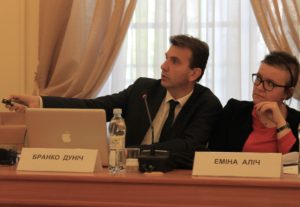 Branko Dunjic, Chief Technical Advisor of the UNIDO project, focused on the Centre’s technical expertise to be one of highest within other similar Centres actively operating worldwide.
Petra Schwager, UNIDO Project Coordinator for RECP, noted: “We put our efforts to further strengthen the Centre and prepare it for its independency and reach sustainability in coming years. We also support the idea of large-scaling the Centre’s area of activity and covering other regions where we will see a business”. P.Schwager advised another task to do. “This is the work with the Government, and through the work in the companies bringing additional information to the Government to establish efficient policy to industrial development – how it can be stimulated, what we are giving to industry to make them pick up with resource efficiency. So this is a very important role of the Centre – to have a long-term national responsibility”.
Oleksandr Chernykh, the Director of Industrial Policy Department at the Ministry of Economic Development and Trade of Ukraine, assured all the SC participants that cooperation with the Center is extremely important if viewing the current right moment when efficient industrial development strategy in Ukraine is being elaborated and has become the key task for the relevant Ministry. Mr. Chernykh hopes in the future the Ministry will become capable in providing Ukrainian companies with an opportunity for BAP exchange in resource and energy efficiency. One day there must appear a magic click on the Ministry’s web-site, so when you click, you are granted this option. “Useless to stress again how crucial is the Centre’s experience is for the Ministry operation”, added Alexander Chernykh.
Taras Sakalosh, the RECPC Executive Director, emphasized on the fact, that no successful work of the Centre could have become possible if not the constant and comprehensive support to the project had been delivered by the international partners and donors, primarily UNIDO, the Governments of the Swiss Confederation and the Republic of Austria.
Following the Steering Committee meeting, a number of decisions were made – all of them focused on further growth of the Center and disseminating the RECP methodology and BAPs in Ukraine.