

UNDERSTANDING THE BASICS OF CIRCULAR ECONOMY IS KEY TO SUSTAINABLE DEVELOPMENT IN UKRAINE


The importance of theoretical and practical knowledge of the circular economy (CE), as well as the country’s transition to it, is one of the key stages on the path to sustainable development in Ukraine. This was the main message of an online event organised under the EU4Environment Action, led by UNIDO and in cooperation with the RECP Centre in Ukraine.
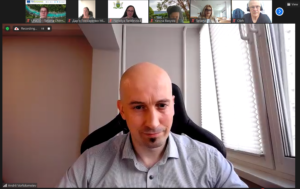
On the 6th of June, an online event “BUILDING NATIONAL KNOWLEDGE ON CIRCULAR ECONOMY” was held to present the Ukrainian-language online course ‘Circular Economy in Ukraine: Implementation Support’. The course examines the meaning of circular economy, its principles, strategies, practices and business models, as well as the means to promote its implementation at the national or municipal level. It includes practical examples from Ukraine and around the world and will be of interest to policymakers (at various levels), civil society and anyone interested in promoting the circular economy in Ukraine. The course was presented to the participants by Mr. Andrii Vorfolomeiev, Director of the RECP Centre. He spoke in detail about the history of the course, the search for specific language equivalents to English terms, the challenges in developing the course content, interviews with stakeholders, the requirements to pass the tests, and the algorithm for signing up for the course on the UNIDO platform. The RECP Centre Director also presented to the participants a collection of national circular economy case studies developed under the EU4Environment Action. It contains successful examples of the implementation of CE principles, practices and policies in Ukrainian industrial enterprises.
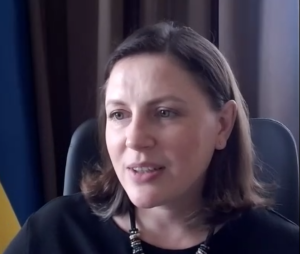 Current trends in economic growth provoke the consumption of more and more resources, causing pollution. The circular economy aims to change this, as it is a different economic model that helps to reduce environmental risks, conserve resources and increase business competitiveness. Ms. Nadiia Bihun, Deputy Minister of Economy of Ukraine, noted that the circular economy is an effective alternative to the linear economy due to its obvious advantages in economic, social and environmental aspects of green growth. Today, Ukraine needs to turn current challenges, such as waste management, into opportunities. The Ministry of Economy has set up working groups that meet regularly to discuss pressing issues. “Making as many people as possible aware of the principles of circularity will create favourable conditions for economic recovery. The circular economy means new business opportunities, the ability to create value added where there was waste before. I urge participants to take the online course and learn the principles and practices of the circular economy,” finalized her speech Ms. Nadiia Bihun.
Ms. Angela Bularga, Programme Manager, DG NEAR, European Commission, assured that the European Union has always supported and will continue to support initiatives in Ukraine on resource efficiency, environmental protection, achieving sustainable development goals, etc. With the long-term goal of EU integration in mind, Ukraine is overcoming obstacles and challenges, such as the ongoing war. The European Union is always ready to help Ukraine, especially in the current difficult circumstances. This includes investment projects for waste mapping, practical advice on how to improve the resource efficiency of industrial enterprises, the use of various tools and the implementation of various strategies, as well as a new programme for the greening of Eastern Ukraine.
In particular, Ms. Tatiana Chernyavskaya, EU4Environment Project Manager, UNIDO, reported, “Over the years of the EU4Environment Action, we have managed to build a partnership with the Government of Ukraine, in particular the Ministry of Economy and the Ministry of Environment, and to create a broad community of experts. For example, more than 200 Ukrainians have participated in the Foresight project and contributed to its outputs, demonstrating the strong interest of Ukrainians in circular economy issues. Now Ukraine has an online course available on the UNIDO platform, which we are announcing today, and this is a big step forward because it will convince the general public and especially the municipalities at various levels of the benefits of this economic model. The circular economy and the use of its practices are the key to Ukraine’s sustainable development”.
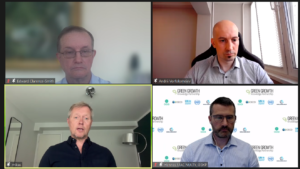 In the first panel discussion, Mr. Edward Clarence Smith (UNIDO), Mr. Mika Sulkinoja (Sitra) and Mr. Hannes MacNulty (Green Growth Knowledge Partnership) discussed how to achieve the required level of knowledge on circular economy in Ukraine and how to build national capacity. Special attention was also given to highlighting current trends in the development of national circular economy knowledge.
In the second panel, Ms. Daria Honcharenko (Department of Real Sector Development, Ministry of Economy of Ukraine), Ms. Olena Maslyukivska (National University of Kyiv-Mohyla Academy), Mr. Massimiliano Rumignani (AMBIT) and Ms. Kateryna Kopishynska (National Technical University of Ukraine ‘Igor Sikorsky Kyiv Polytechnic Institute’) lively discussed current circular economy initiatives in Ukraine, existing knowledge networks and their role in promoting the circular economy. Challenges and barriers to the uptake of circularity were also identified. Thus, Ms. Olena Maslyukivska identified inertia in society and thinking, lack of knowledge, lack of convincing examples, lack of skills and lack of coordination and experience as barriers. Drivers are rapprochement with the European Community, international cooperation and donor funding.
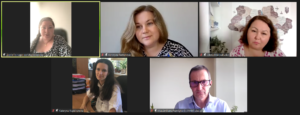 The event gathered over 120 participants, those were the representatives from the Ministry of Economy of Ukraine, the Ministry of Environment, industrial enterprises, central and local authorities, business associations, NGOs, academia and others.
At the end of each logical part of the event, the participants were able to ask questions to the panelists.
Background
The “European Union for Environment” (EU4Environment) Action aims to help the EU’s Eastern Partnership countries to preserve their natural capital and increase people’s environmental well-being by supporting environment-related action, demonstrating and unlocking opportunities for greener growth, and setting mechanisms to better manage environmental risks and impacts. The Action’s implementation period is 2019-2024. For more details, please click here.
