

GREEN CHEMISTRY: INNOVATIVE APPROACHES IN THE DESIGN FOR NEW PRODUCTS

On 27 September 2023, within the framework of the International Conference on Chemistry, Chemical Technology and Ecology dedicated to the 125th anniversary of the Igor Sikorsky Kyiv Polytechnic Institute, a seminar “GREEN CHEMISTRY: INNOVATIVE APPROACHES IN THE DESIGN FOR NEW PRODUCTS” within the framework of the GreenChem Programme (Global Green Chemistry Innovation and Networking Programme).
 Tetiana Dontsova (Head of the Department of Inorganic Substances Technology, Water Treatment and General Chemical Technology at the National Technical University of Ukraine “Igor Sikorsky Kyiv Polytechnic Institute”) opened the seminar with a welcoming speech, stressing that highlighting green chemistry and promoting it as a science is very relevant today because “All mankind should care about improving the environment”.
 Lars Ratjen, GreenChem Manager at the Center for Green Chemistry and Green Engineering of the Yale University (USA), presented the GreenChem Programme, its objectives and three components, participating countries, etc. He emphasised that chemistry is present in our daily lives and therefore the consequences of its use are tangible for the environment (such as polluted water, depletion of resources, irrational use of chemicals to maximise profits, accumulation of plastic waste, accidents at chemical plants, processes and materials that cause climate change). “Green chemistry has good intentions. It’s a framework that tries to rethink chemistry, chemical processes to reduce the use of hazardous substances, and the chemical industry in general. Green chemistry cares about the renewability and non-toxicity of consumer goods; green chemistry is an essential tool for a sustainable future for humanity,” reported the speaker.
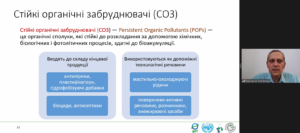 Oleksandr Khokhotva, an chemical management expert at the RECP Centre, spoke about the principles of green chemistry and their role in creating safe environment and production conditions. Having the greatest impact on environmental and industrial safety, the main principles include the selection of safer raw materials, the design of safe, non-toxic products and the design of products that are not environmentally stable and can be decomposed, thus avoiding their accumulation. Production safety is significantly improved by avoiding or minimising the use of solvents.
Oleksandr noted that continuous analytical control over the production process allows real-time monitoring of processes and prevention of pollution and hazardous waste generation, rather than simply measuring the quantities after they have been generated. The speaker also stressed that the chemical pollution we see today is due to the use over decades of a number of chemical compounds that we now classify as persistent organic pollutants (POPs). “The task of improving the environmental safety of production is a complex one and is best achieved by implementing the principles of green chemistry throughout the product life cycle,” concluded O. Khokhotva.
 Branko Dunjic, Director of the Cleaner Production Centre in Serbia, introduced participants to the principles of chemical leasing, which has long been used in Europe and around the world and is an innovative business model for the use of chemicals in companies, farms, households, etc. The essence of chemical leasing is simple: the consumer orders from the supplier not a certain amount of chemicals for his purposes, but a service/function and further maintenance (e.g. painting, fertilising, cleaning, lubricating, etc.). This method helps to rationalise the use of chemicals, as a correct calculation of chemical consumption per unit area, weight or volume of goods not only prevents the purchase of unnecessary chemicals, but also saves money. “Both the service provider and the consumer benefit from the chemical leasing model,” emphasized Branko Dunjic.
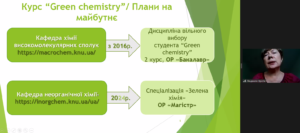 Liudmyla Vretik, Professor of the Macromolecular Chemistry Department, Faculty of Chemistry, Taras Shevchenko National University in Kyiv, spoke about the introduction of a green chemistry course into the curriculum. The idea of a green chemistry course came to the university 10 years ago, as the terms “green technologies”, “green solvents” and “green chemistry” were already being used in everyday life. Liudmyla Vretik said that many heard the echo of green terminology but did not understand it, which prompted the university experts to change the programmes of the Faculty of Chemistry. She added: “Ukrainian society is still not sufficiently informed about the approaches and principles of green chemistry, and there is a lack of specialists in this field in Ukraine, especially textbooks, as the most professional and reliable reference materials are English manuals.
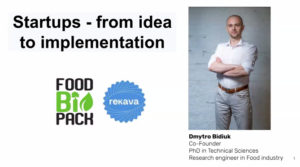 “From Theory to Practice” was the title of the presentation by Dmytro Bidiuk, co-founder of FoodBIOPack (established in 2018) and REKAVA. The very names of the two brands made it clear that the company’s core business is the production of biodegradable packaging and the recycling of used coffee grounds. Dmytro gave some historical background for REKAVA, how it has developed a process for producing biodegradable disposable tableware and unique decorative scented candles in biodegradable containers – all made from recycled coffee grounds. This experience is very interesting and useful, because if millions of consumers prefer eco-friendly packaging and eco-products, it will help to improve the environment. “REKAVA is a small Ukrainian company with a big social mission” – that’s the company’s motto.
 The side panel was open to all participants of the International Conference on Chemistry, Chemical Technology and Ecology dedicated to the 125th anniversary of Igor Sikorsky Kyiv Polytechnic Institute; to all stakeholders interested in and working on issues related to chemical sector, green chemistry, industry, circular economy, resource efficient and cleaner production, and environmental protection.
In general, participants showed great interest in the topics covered in the workshop, as evidenced by the interactive part of the event with numerous questions to the speakers.
Almost 190 participants joined the online event, the gender segregation was 70% females and 30% males.
Video of the event here.
The workshop was organised by the Centre for Resource Efficient and Cleaner Production in partnership with the Center for Green Chemistry and Green Engineering at Yale University (USA) as part of the UNIDO Global Green Chemistry Innovation and Networking Program (GreenChem) project, funded by the Global Environment Facility (GEF).