04116, Kyiv, 10-G, Starokyivska Str. +380 44 227 83 78 info@recpc.org
  • Українська
Circular economy, resource efficiency, and green chemistry

European Union for Environment in Ukraine

"Circular Economy and New Growth Opportunities" component within the framework of the European Union for Environment (EU4Environment) Action for Eastern Partnership countries

At a Glance

Years

2019-2024

Component elements

  • Resource Efficient and Cleaner production (RECP)
  • Circular Economy and Industrial Waste Management (CE&IWM)
  • Single Market for Green Products (SMGP)

Component goals

  • Enhancing national responsibility for the greening of the national economy
  • Promoting awareness raising and education
  • Public recognizing the need for a transition to a green economy
  • Scaling-up the implementation of RECP methodology in national industries
  • Applying strategic approaches to waste management
  • Support to green economy reforms
  • Single market for green products: introduction and demonstration

Target audience

Representatives of small and medium-sized businesses (SMEs), government agencies, public organizations and associations, academia, international organizations, etc.

RECP Centre's role

Implementing partner for the “Circular Economy and New Growth Opportunities” component

What are the component elements?

Resource Efficient and Cleaner Production

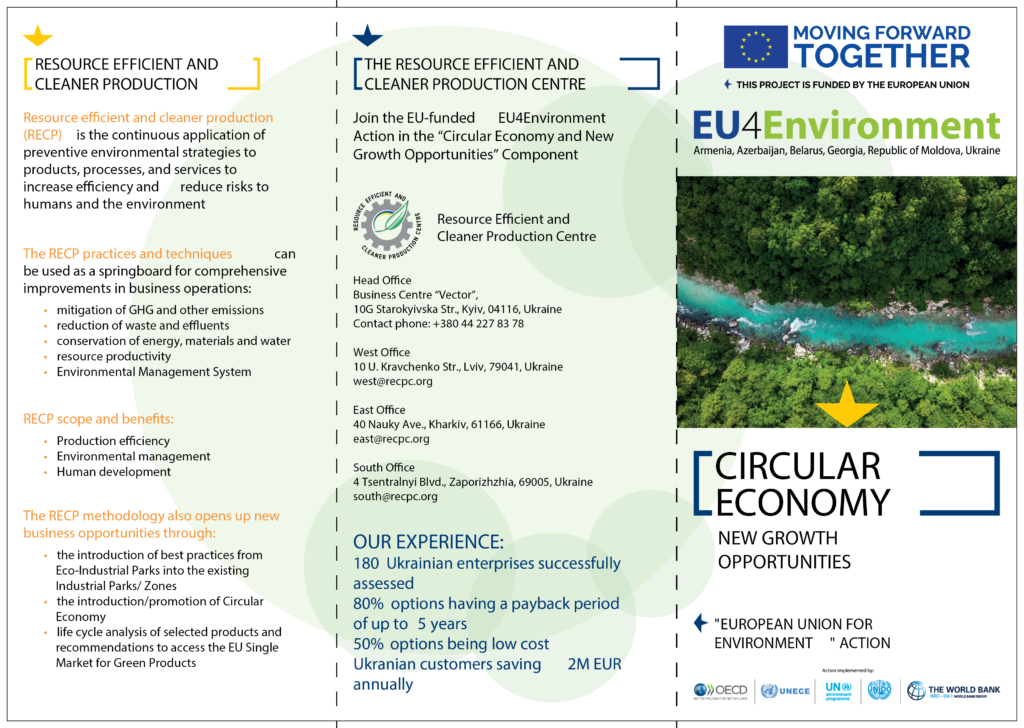
Resource efficient and cleaner production (RECP) entails the continuous application of preventive environmental strategies to processes, products and services in order to increase efficiency and reduce risks to humans and the environment

Circular Economy and Waste Management

Circular economy is an alternative to the traditional linear economy. This economic model maximizes the use of the materials extracted from nature. Each non-biodegradable material is reused, remade and recycled (3R principle) in order to reduce the negative impact on the environment

Single Market for Green Products

Single market for green products (SMGP) initiative envisages developing a common methodology on the quantitative assessment of environmental impacts of products, throughout their life-cycle, in order to support the assessment and labelling of products. This initiative will have an impact on companies that export to Europe

Activities

The Circular Economy (‘CE’) is a transformation in progress in many countries around the world. For Ukraine as with others, there are many benefits:

  • Increase income for business and the wider economy
  • Reduce dependence on external resources
  • Minimize waste and pollution
  • Reduce environmental footprint

Such transformation depends on forming new synergies, between many sectors of business, many material streams, and many locations.
To make sense of this, to look ahead at the challenges, to mobilize the visions, and turn these into practical actions – this is the role of foresight and strategic thinking

Some statistics

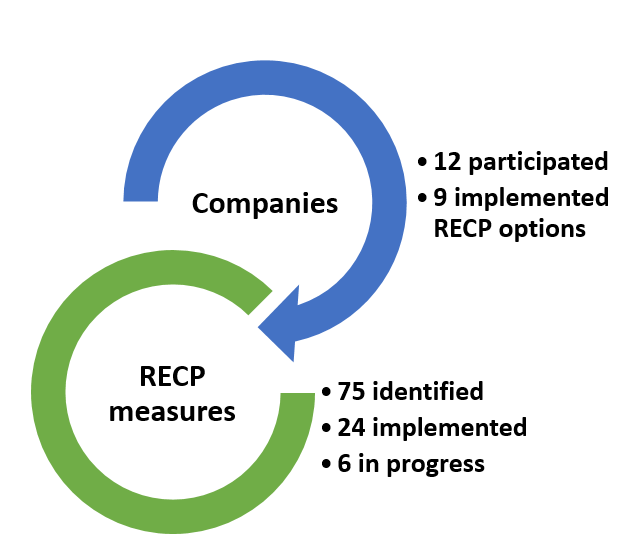
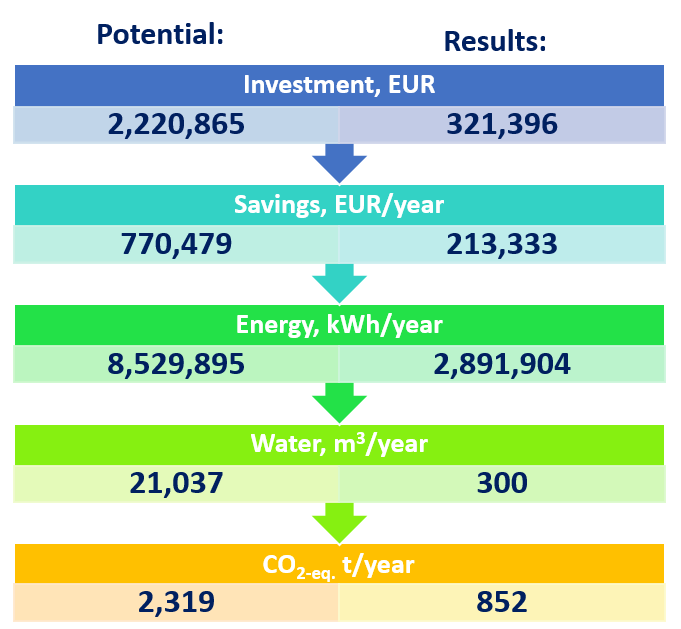
Potential for 12 companies identified and monitoring results

A total of 12 manufacturing compannies were assessed using the RECP methodology (8 medium-sized, 2 large and 2 small) representing
     – engineering
     – light industry
     – food industry
     – chemical industry  
and
     – construction 


The demonstration companies were interested in participating in the project and even started to implement new measures they had developed themselves. This was probably stimulated by the RECP training, which included the establishment of an internal RECP team within the companies. As a result, measures to improve working conditions or responsible business practices were implemented (in addition to the main measures to reduce energy and material consumption).
For one of the food processing companies, for example, the RECP assessment became a strong incentive to intensify energy saving activities and is now focused on restructuring the whole company.
The analysis shows that at least 30% of the proposed measures are implemented in the first months after the company receives the RECP assessment report.
Therefore, all demonstration companies within the EU4Environment Action received: RECP assessments and RECP measures developed, training on RECP methodology and investment proposals for measures they consider to be a priority. The companies will soon also receive business cases, which are in the final stages of approval.

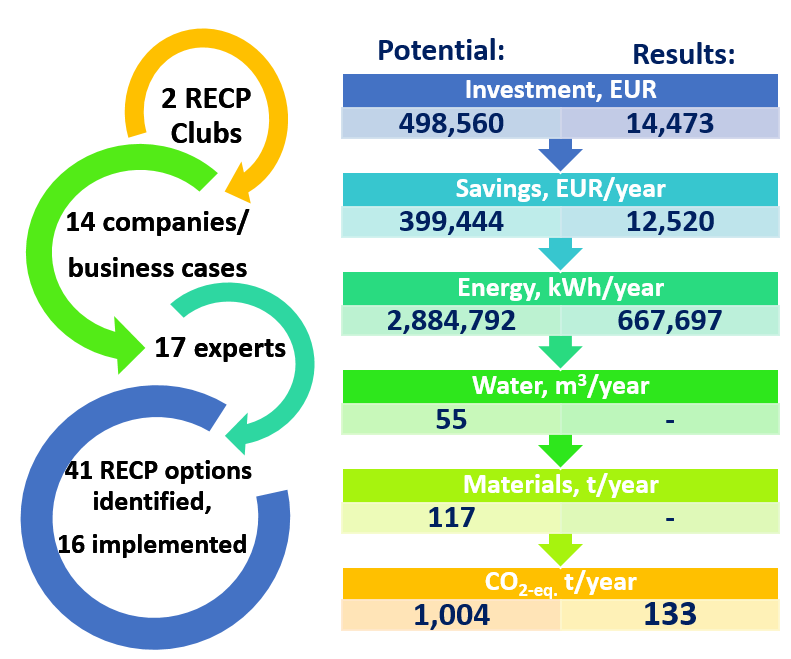
RECP Clubs in Ukraine

Khmelnytskyi and Poltava regions

     – 6 training modules conducted in each region
     – Technical reports with identified options were developed and presented to the companies-participants
     – To support the activities of RECP Clubs, the results of the EaP GREEN project and the developed training and informational materials are being used
     – Each company-participant developed an action plan to enhance resource efficiency

Certificates for the RECP Clubs Participants

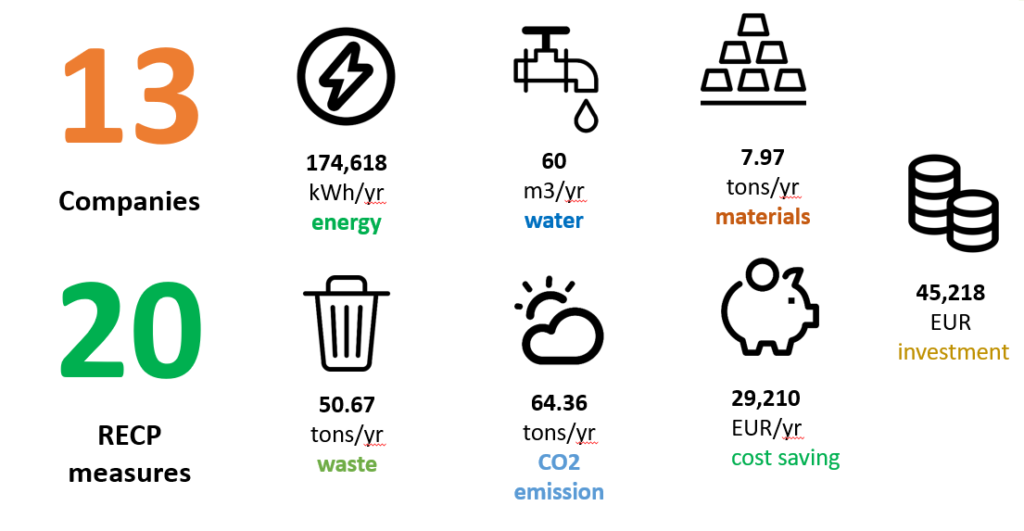
RECP Clubs in Moldova

Outcomes

     – Public organisations can use the RECP Clubs knowledge base materials to create and develop Clubs in different areas of activity
     –
Municipalities can use the Clubs as an effective tool to support local businesses
     –
New experts from the Republic of Moldova will be able to provide technical support to the Clubs and take part in international projects.
     –
The RECP Centre’s experts can also assist in the implementation of international projects in consortium format.

RECP assessments in Moldova

Waste Mapping for Two Pilot Municipalities

Davydiv Village Territorial Community/municipality,
Lviv oblast

Slavuta City Territorial Community/municipality,
Khmelnytska oblast

Cumulative findings

Business Cases

  • The implemented options were monitored at the demonstration companies as part of the EaPGREEN project
  • Templates for 8 business cases in English and Ukrainian developed
  • Search for demonstration companies done
  • Reports on the RECP assessment results developed
  • Business cases at 15 demonstration companies in 2 RECP Clubs developed

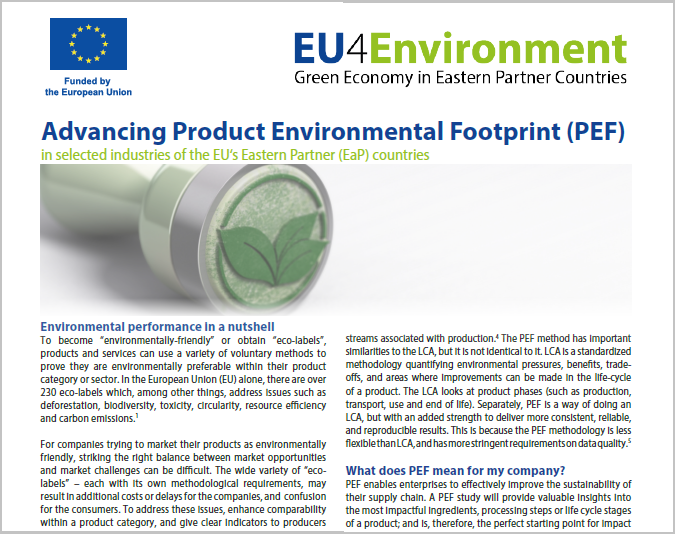
Product Environmental Footprint

Product Environmental Footprint (PEF) is an approach based on Life Cycle Assessment (LCA) to quantify the environmental impacts of goods or services. It was developed by the European Commission to harmonise and improve the information on the quality and sustainability of products for the consumers, encouraging, thus, the consumption and production of sustainable products in the EU Single Market. The PEF methodology defines how a producer can calculate and communicate an environmental score of a product by covering its entire life-cycle.
More about the PEF methodology here.

Supporting green industry recovery

The Centre is expanding its activities under Output 2 – “Circular Economy and New Growth Opportunities” of the EU4Environment Action in Ukraine by piloting the introduction of the single market for green products (SMGP) and product environmental footprint (PEF) in Ukraine and supporting green recovery of industrial companies. The relevant stakeholders include businesses, experts, government institutions and academia.

Tasks

  • Map the recovery needs of relocated industrial companies and recovery opportunities in target regions
  • Support the green industrial recovery, providing direct consulting to the companies
  • Identify and promote financial opportunities for the green recovery of relocated companies
  • Develop and promote business cases and a factsheet of relocated companies extrapolating the results to cover resilience of their respective industries

Topics for consulting

  • Availability of resources (materials, energy, water, workforce) and resource security (including energy security)
  • Suppliers mapping
  • Accessibility to waste management opportunities and safe waste management
  • Resource efficient and cleaner production (screening of opportunities) – BAT 
  • Industrial symbiosis
  • Emergency preparedness.

Findings

The results of the survey (developed by the RECP Centre for Ukrainian Manufacturing Enterprises Relocated during War) were processed and compiled into a report entitled “Needs and Opportunities of Relocated Enterprises for the Recovey of Ukrainian Industry”.

Certificates granted to PEF trainees

Online Trainings and Events

Reference

Programme goal

Help the partner countries preserve their natural capital and increase people’s environmental well-being by supporting environment-related action, demonstrating and unlocking opportunities for greener growth, and setting mechanisms to better manage environmental risks and impacts

Five Programme Components

  • Greener Decision-Making and Objective
  • Circular Economy and New Growth Opportunities
  • An Environmental Level Playing Field
  • Ecosystem Services and Livelihoods
  • Knowledge Sharing and Coordination

EU4Environment in social media

This web page was produced with the financial assistance of the European Union. The views expressed herein can in no way be taken to reflect the official opinion of the European Union, its members or the Governments of the Eastern Partnership Countries. This web page and any content included herein are without prejudice to the status of, or sovereignty over, any territory, to the delamination of international frontiers and boundaries, and to the name of any territory, city or area

For more information about the EU4Environment Action please click here